
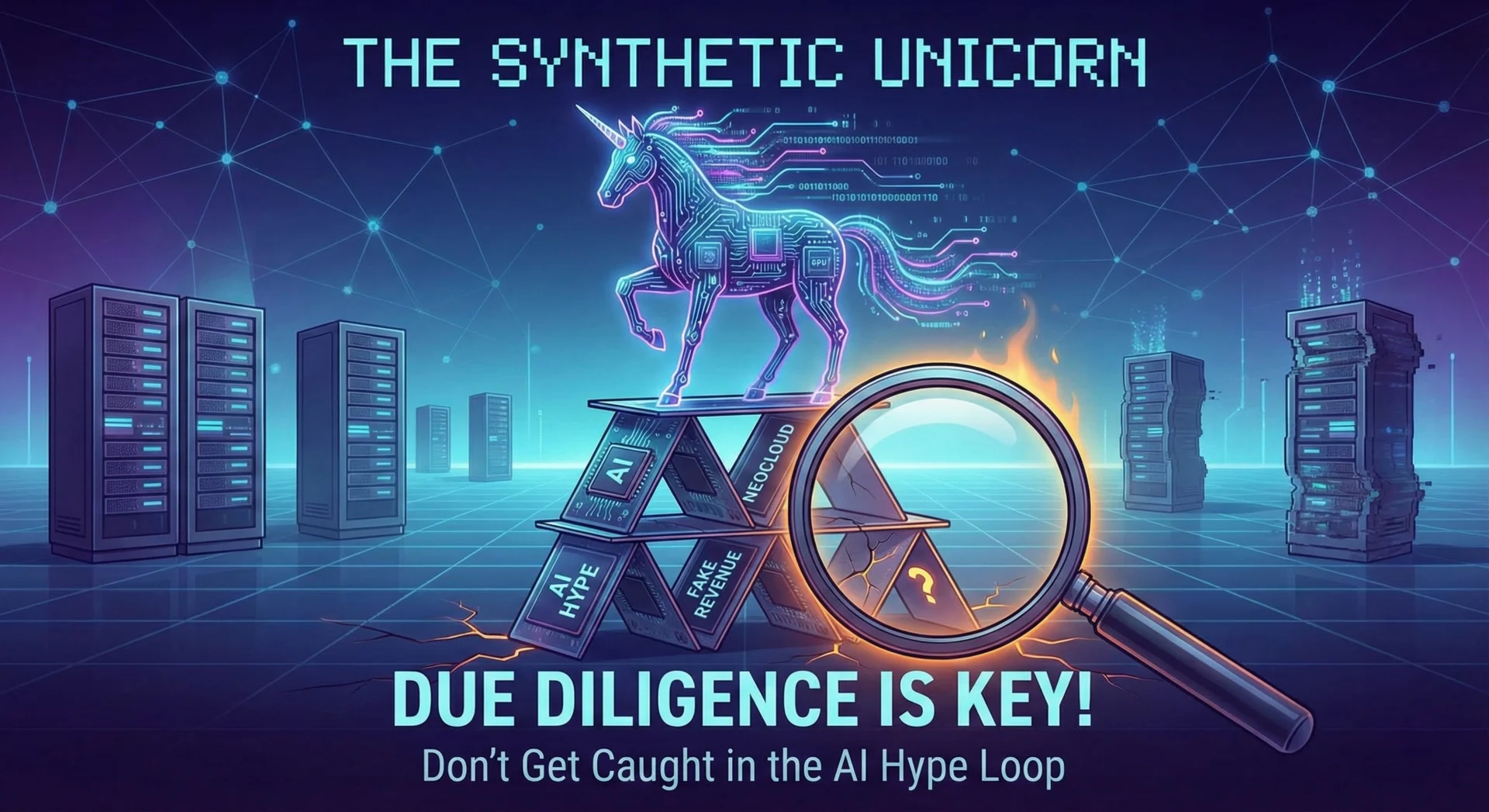
How AI Neocloud Infrastructure Turns Circular Cash Flows Into Fake Growth
Executive Summary
The interval between 2023 and 2025 has birthed a capital allocation phenomenon arguably without precedent: the “Synthetic Bubble.” Driven by the scramble for AI dominance, the venture capital apparatus has directed billions into the “Neocloud” ecosystem. However, a rigorous analysis suggests that up to 40% of this sector is built upon structural malfeasance.
This report posits that the sector is distinct from traditional bubbles in that underlying asset values are not merely inflated, but actively manufactured through circular financing, “vaporware” infrastructure, and predatory legal structures.
Section I: The Neocloud Arbitrage and the Illusion of Infrastructure
A large share of today’s “AI Neoclouds” sits on top of footprints originally built for other workloads, including cryptocurrency mining. When those economics broke after the 2022 crypto crash, some operators executed a rapid pivot, rebranding existing facilities as “AI Data Centers” without fully closing the gap between what the sites were designed for and what LLM training actually requires.
1.1 The Pivot: From Crypto-Mining to AI-Grifting
The result is an operational mismatch: facilities with power and space, but often without the necessary cooling density, redundancy, and networking to reliably support modern AI training clusters. In the worst cases, these environments are marketed as if they were born-AI infrastructure, when in reality they are still in a transitional state, capable of running some GPU workloads, but not the scale, reliability, or SLA profile implied in the pitch.
1.2 The Brokerage Trap and “Noisy Neighbors”
A defining characteristic of the unethical Neocloud is the decoupling of asset ownership from service delivery.
- Layer 2 Reselling: Many startups lease capacity from third parties, slap a UI on it, and resell it at a markup. They market access to a supply chain queue as ownership of a deployed resource.
- Oversubscription and Phantom Capacity: To make the numbers work, some Neoclouds sell the same GPU to multiple customers and sell future capacity they don’t yet have. On paper, it shows up as healthy contracted ARR. In practice, when those customers all try to train concurrently, there aren’t enough GPUs to go around, queues explode, SLAs break, and performance craters.
- The Hype-Only Deal Pipeline: On top of this, a significant portion of the “big wins” marketed to the press and investors never make it past the press release. Multi-million/billion dollar “strategic deals” are announced off the back of tiny pilots, experimental credits, or non-binding MOUs. The logo slide and the headline travel; the actual deployed workloads do not. On paper, it looks like an infrastructure business at scale. On the ground, very little is physically happening beyond a small fraction of what’s being shouted about.
Operational Divergence: Hyperscaler vs. Unethical Neocloud
| Operational Metric | Legitimate Hyperscaler | Unethical Neocloud Startup |
|---|---|---|
| Asset Ownership | Owns physical data centers, fiber, and custom silicon. | Leases capacity; acts as a layer-2 reseller or broker. |
| Resource Allocation | Strict isolation of tenant workloads via hypervisors. | Aggressive oversubscription (selling 1 GPU to 3 users). |
| SLA Transparency | Public, audited uptime and latency metrics. | Opaque SLAs; “best effort” performance disguised as guaranteed. |
| Virtualization | Mature hypervisors (Nitro, Titan) minimizing overhead. | Thin/Non-existent virtualization causing security risks. |
| Compliance | SOC2, HIPAA, FedRAMP inherent to infrastructure. | Compliance is “roadmap” or self-attested; often non-existent. |
| Power Redundancy | N+1 or 2N redundancy for all critical path power. | Single-path power; susceptible to brownouts and failures. |
Section II: Financial Engineering and the Circular Revenue Economy
As interest rates squeezed traditional capital, the ecosystem turned inward, cannibalizing its own capital to feign growth.
2.1 The Venture Capital “Round Trip”
This mechanism is designed to artificially inflate Annual Recurring Revenue (ARR) using a single injection of capital.
- The Investment: A VC firm invests $100M into Neocloud Startup A.
- The Stipulation: The VC invests $50M into Model Creator B, mandating they use Startup A for compute.
- The Loop: Startup B transfers capital back to Startup A as “cloud revenue.”
Result: Both companies show massive growth, but the same dollar is simply spinning in a circle.
2.2 Wash Trading and the “Sham Pilot”
Startups are engaging in direct “wash trading”, swapping checks to meet Series B metrics. Company X buys software from Company Y, and Company Y buys compute from Company X. In more egregious cases, startups run “paid pilots” where the customer is secretly reimbursed via off-book “marketing fees,” allowing the startup to book a fraudulent contract as “Committed ARR.”
Section III: The Human Capital Façade
The deception extends to the human element. The pressure to scale has fostered a culture of “fake it till you make it” that borders on criminality.
- The “Mechanical Turk” AI: Startups claim to have proprietary “autonomous agents,” but in reality, complex tasks are routed to low-cost human labor pools. The user thinks they are interacting with an AI; they are actually waiting for a human in a server farm to type a response.
- Ghost Engineers: To signal headcount growth to investors, some startups utilize bot farms to create fake LinkedIn profiles, populating their “Team” page with employees who do not exist.
- Optics Hiring: Executives are hired solely for their pedigree (ex-DeepMind, ex-Meta) or even Phd’s with absolutely no real work experience whatsoever, just another name on a piece of paper with a phd and no accomplishments whatsoever to serve as figureheads for pitch decks, while unqualified founders make the actual technical decisions.
Section IV: Predatory Contracting and The View from the Trenches
The monetization strategy of the unethical Neocloud is often predatory, relying on entrapment rather than value.
4.1 The “Choke Contract” Mechanism
Demand for GPUs has allowed providers to enforce “Take-or-Pay” contracts. These agreements require customers to pay for reserved capacity regardless of performance, often demanding 50-100% upfront payment. The startup uses this cash to fund the hardware they claimed to already own, effectively using the customer’s money to fund their own CapEx.
4.2 View from the Trenches: The “Picks and Shovels” Reality
Our firm operates in the physical reality of this sector, helping these Neoclouds set up the actual “picks and shovels” infrastructure. We see the operational truth that marketing decks hide.
We have observed a disturbing pattern: for these companies to survive the burn rates demanded by their valuation, they are forced to sign “Choke Contracts” with Service Level Agreements (SLAs) that are, frankly, insane. We have reviewed contracts containing uptime guarantees and latency promises that are physically impossible given the facility’s cooling and power constraints. Things that would make any engineer’s eyebrows go mad.
Why do they sign them? Desperation. The founders know the infrastructure can’t support the SLA, but they need to show investors “Signed Contracts” to unlock the next tranche of funding. It is a game of musical chairs where the music is kept playing by impossible promises.
4.3 Data Hostage Situations
Once a customer migrates data in, “zero egress fee” marketing evaporates. Startups use proprietary formats and bandwidth throttling to make leaving impossible, effectively claiming ownership over “derived data” (the trained model weights) to lock clients in legally.
Section V: The Marketing-Deployment Imbalance
A hallmark of the fraudulent startup is the inversion of capital allocation. Instead of funding R&D, funds are diverted to the “Hype Machine.”
- Logo Slapping: Startups frequently list Fortune 500 companies as “Partners” based on a single developer using a free trial. This is designed to mislead investors into believing enterprise traction exists.
- Fake Acquisitions: Startups engage in non-material “acquisitions” of failing companies (often owned by friends) to simulate momentum. They issue press releases announcing “Market Consolidation” to drive up the valuation before the lack of product delivery becomes apparent.
Section VI: The Due Diligence Void
This ecosystem thrives because the “Smart Money” has abdicated its responsibility. Driven by FOMO, VCs are skipping technical audits and site visits. They are investing in the slide deck, not the business.
The reliance on “Total Addressable Market” (TAM) projections, “If AI is a $10 trillion market, we only need 0.1%”, has replaced unit economics analysis. This justifies funding companies with negative gross margins and no path to profitability.
Section VII: A Field Guide for Investors: How Not to Fund a Synthetic Unicorn
To investors: if you are looking at one of these AI Neocloud stories, understand that you are not buying a narrative, you are underwriting physics, contracts, and incentives.
The current environment is engineered to short-circuit your process. Media noise, logo slides, breathless ARR headlines, and “AI infrastructure” positioning all exist to trigger FOMO and suppress actual due diligence. The only real defense is to slow the process down and bring in people who live in the wiring closet, not on the conference stage.
At a minimum, do the following before you wire a single dollar:
- Send a real team on-siteNot just the partner and an associate. Bring independent data center engineers, power and cooling experts, and network architects. Verify that there is something physical behind the deck: real racks, real power, real cooling, real fiber, real redundancy. If they won’t let you see the “production” site, you’ve already got your answer.
- Cross-check the infrastructure against the promisesTake the marketing claims (uptime, latency, training cluster size, GPU type and count, redundancy, “AI-ready”) and map them to what you see in the facility. Does the power envelope, cooling design, and network fabric actually support the SLA and the cluster diagrams? If the physics don’t close, the model doesn’t either.
- Have experts tear through the contracts and SLAsDon’t just skim the term sheet. Get specialist counsel to read the master service agreement, SLAs, take-or-pay clauses, egress terms, derived-data language, and liability caps. Ask a simple question: If this thing behaves the way the facility looks, how many of these contracts are already in technical breach on day one?
- Interrogate the revenue quality, not just the revenue lineDisaggregate “ARR” into: related-party deals, VC round-tripping, paid pilots, rebates, and vendor-financed contracts. Look for circular flows (“our investor is also our biggest customer”), sham pilots, side letters, and “marketing fees” that mysteriously offset customer spend. Growth that collapses when you remove these is not growth; it’s choreography.
- Diligence the humans, not just the LinkedIn pagesVerify that the key engineers, SREs, and infra leads actually exist, actually work there, and actually have the experience implied. Push beyond the optics hires and logo CVs. If the pitch leans heavily on ex-brand names and PhDs with no delivery track record, you are likely looking at a signaling strategy, not an execution engine.
In a healthy deal, these steps are mildly uncomfortable and mostly confirmatory. In a synthetic one, they are explosive. You will find mismatches between facility and SLA, between contracts and reality, between “ARR” and actual cash economics.
Mark our words: we have run this playbook multiple times. Every time we have been allowed to look under the hood, something material was off.
If you are not willing to fund this level of diligence, on-site, technical, contractual, and human, then understand what game you are really playing. You are not investing in infrastructure. You are volunteering to be the last, most expensive ticket holder to a show that is already over.
Section VIII: The Inevitable Burst
We are witnessing a “Synthetic Bubble.” It will not burst because AI is fake, AI is real. It will burst because the financial delivery vehicles built to capitalize on it, the unethical Neoclouds, are structurally unsound.
7.1 The Warning to Late-Stage Investors
When the “circular” revenue stops spinning and the “take-or-pay” defaults begin, the liquidity crisis will be swift. The current wave of marketing and shouting is designed to attract the next layer of capital, the late-stage investors and PE firms, who think they are buying into a high-growth infrastructure play.
They are not.
They are buying into a liability time bomb of breached SLAs, oversubscribed hardware, and circular revenue that will evaporate the moment the funding stops. The market will eventually clear, but it will wipe out the “paper unicorns” that prioritized press releases over engineering.
Section IX: Why We’re Writing This
We’re writing this because, from the inside, the signal-to-noise ratio in AI infrastructure has collapsed.
Every week, we’re bombarded with announcements of “record-breaking” rounds, “strategic” partnerships, and “nation-scale” AI data centers. A non-trivial share of those headlines are either wildly exaggerated or structurally unsound: circular deals, paper capacity, MOUs marketed as deployments. The hype is not just annoying; it’s misallocating billions.
But that’s only half the story.
We’re also writing this because we still believe this market can be built on real engineering, real contracts, and real outcomes. There are companies, including ours, that are doing the unglamorous work: designing and deploying actual infrastructure, pushing metal and electrons, reading the SLAs before signing them, and refusing to fund operations with choke contracts we know can’t be honored.
We don’t get the same spotlight as the loudest “unicorns”. We don’t publish breathless “AI revolution” press releases every quarter. We don’t backfill reality with marketing, and we don’t sign impossible SLAs just to unlock the next funding round. We take the slower, harder, ethical route: build real capacity, tell the truth about what it can do, and then scale it.
This article is our attempt to tilt the game, even slightly, back toward those incentives. If investors reward doing over shouting, the market will correct faster, less capital will be incinerated, and the operators who actually deliver will finally get the room to show their real strength.
Referenced Data & Citations
- Fraudulent Marketing & Scams:
- Circular Revenue & Financial Engineering:
- Neocloud/GPU Brokerage Issues:
- Toxic Culture & Hiring:
- Contracting & Vaporware:
- Market Correction Indicators:
References
- AI investments in 2025: strategies VCs are using to navigate industry shifts | Vestbee
- The Algorithm That Detected a $610 Billion Fraud: How Machine Intelligence Exposed the AI Industry’s Circular Financing Scheme : r/STEW_ScTecEngWorld – Reddit
- The Rise of the “Fake” Data Center Developer , And How to Tell the Difference
- [D] Together AI hits $100M in ARR but it just resales compute – hype? : r/MachineLearning
- How does GPU oversubscription impact the cost of running high-performance computing workloads in the cloud?
- What’s the oversubscription of resources in cloud computing? – Stackscale
- Should we worry about AI’s circular deals? – Marginal REVOLUTION
- Concerns raised over circular funding between A.I. startups & service providers – Verus
- Nvidia Deals: Round Tripping Or Vendor Financing? – RIA – Real Investment Advice
- List of Funded Series B Startups (2025) – Fundraise Insider
- NSF announces pilot for startups and small businesses to ‘fast-track’ successful development of technological innovations
- Builder.ai’s $450M Collapse: The Real Story Behind How a Unicorn Cooked Its Books (And Got Away… – Medium
- Nate’s ‘AI’ was just people in a room: Startup founder charged with faking AI, raising $50 million on false claims – The Economic Times
- DOJ indicts five in North Korean fake IT worker scheme – CyberScoop
- EXPOSED: How AI-Generated Phantom Companies Are Infiltrating Corporate Hiring
- The Rise of the “GenAI Unqualified Candidates Wave” and How it Disrupts Recruitment,
- Making GPUs Work For You – Time-Honoured Methods of Maximising Value From Graphics Processing Unit (GPU) Rental Agreements – Squire Patton Boggs
- “We signed what?!”: The Hidden Hazards of Vendor AI Terms and Conditions
- How to Avoid Cloud and ERP Software Vendor Lock-In | The Risks of “One Throat to Choke”
- AI (and other) Companies: Quietly Changing Your Terms of Service Could Be Unfair or Deceptive | Federal Trade Commission
- Startups faking traction (I will not promote) – Reddit
- Why are people putting logos of other companies that have nothing to do with their products on their landing pages? : r/SaaS – Reddit
- AI startup reaped millions using bogus claims, FTC suit says | CFO Dive
- Venture Capitalists Rewrite Rules in Wild AI Startup Investment Boom of 2025
- Debunking Dubious Justifications for the AI Bubble | New Ideas Legal Tech
- The AI bubble: when history rhymes with the doc-com era – Madhyamam
- VCs are growing wary of ‘AI-washing’ , and backing real innovation – TNW
- MIT study shatters AI hype: 95% of generative AI projects are failing, sparking tech bubble jitters – The Economic Times
- FTSE 100 in biggest drop since April as stock market sell-off continues – as it happened
- Finished AI Data Centers Have No Electricity — AI Fraud Can’t Fake Reality – YouTube,
- Southern District of New York | Tech CEO Charged In Artificial Intelligence Investment Fraud Scheme | United States Department of Justice
- AI Fuels New, Frighteningly Effective Scams – AARP
- ‘Very troubling’: AI’s self-investment spree sets off bubble alarms on Wall Street – Reddit,
- Wash Trading: What Is It and How Does It Work? (Examples) – SoFi
- What is a Neocloud? The Rise of GPU-only Clouds – Thunder Compute
- Who’s Responsible for AI? The Rise of Neocloud Middlemen – Lawyer Monthly
- The AI Startup Burnout Myth: Why Crazy Hours Don’t Equal Success – Underdog.io
- 17 Unforgettable Examples of Vaporware – Built In
- AI Vendor Liability Squeeze: Courts Expand Accountability While Contracts Shift Risk
- POC : r/OpenAI – Reddit
- Worried about an AI stock bubble? That might be good news for Nifty bulls