
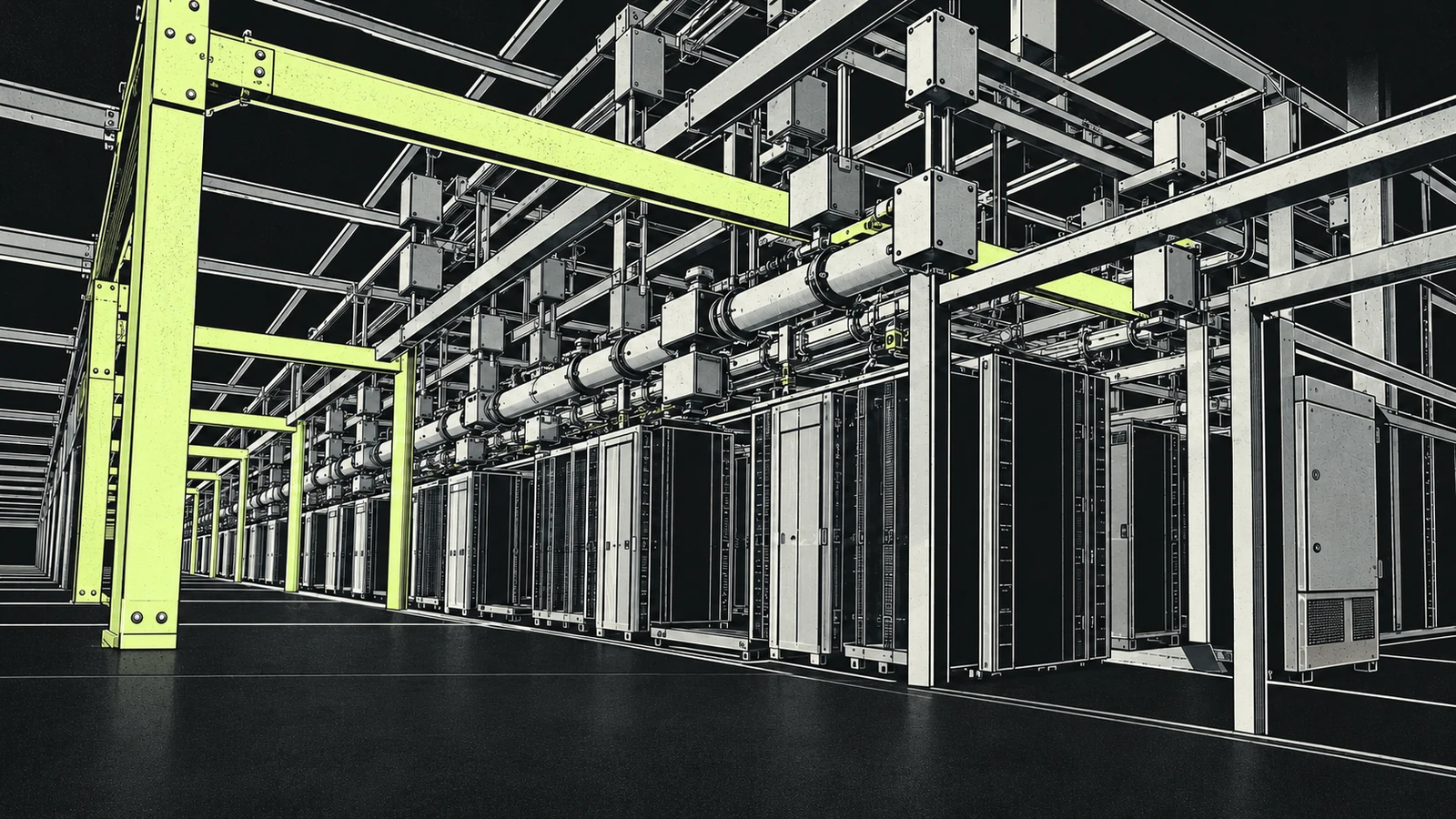
A modular data center should be quicker to deliver and practical to operate for years. NVIDIA's newly announced DSX POD, a reference design for Vera Rubin AI factories, gives that conversation a significant boost. At ElioVP, we welcome it.
Announced on 21 October 2026, DSX POD brings factory integration and validation to partner-built modular containers. NVIDIA expects partner deployments in early 2027 and says installation at a prepared site can take as little as 14 days. That is a final deployment claim with an important condition, not a complete land-to-live project schedule.1
For us, it reinforces the direction behind ModFlex modular data centers: build repeatable infrastructure, complete more work in the factory, and expand capacity through a coordinated plan. It also makes this a useful moment to explain why we moved from freight-container-based IT spaces toward purpose-built modular buildings.
The question we keep coming back to is straightforward: how will this place work after the delivery team has left?
Cover: editorial concept illustration, adapted to ElioVP's visual style. Not a photograph of a delivered facility or a DSX POD specification.
In this article: what a prepared site needs, why modular buildings, the complete cooling picture, and the ModFlex assembly video.
What NVIDIA DSX POD brings to modular AI infrastructure
Factory integration has a compelling logic. Equipment can be assembled under controlled conditions, interfaces checked earlier, and problems resolved before they become problems on a construction site.
NVIDIA brings that approach to a coordinated AI system. Its DSX POD design covers compute alongside networking, storage, electrical distribution, liquid cooling and transport requirements. More cabling, wiring, piping and functional validation happen before shipment. That helps an industry where many suppliers have to deliver one working installation.2
NVIDIA DSX POD rendering supplied with the draft. NVIDIA's reference design, not a ModFlex configuration.
A common design foundation can give customers and delivery partners a better starting point. The implementation can then reflect the location, operating model and infrastructure the customer needs.
NVIDIA's own FAQ recognizes that different construction approaches remain relevant. DSX POD initially targets large greenfield deployments with liquid cooling; conventional buildings and other modular approaches have their place too.3
That is a healthy direction. Customers gain more options, and the discussion can become more specific about what each option delivers.
What a prepared site actually includes
The most consequential words in the 14-day deployment claim are prepared site. Factory integration can shorten final installation, while the location still needs the infrastructure required to receive and operate the equipment.1
Available utility capacity must become a usable supply for the chosen IT system. Depending on the site, that means medium-voltage distribution, transformers, conversion equipment, protection, earthing, backup and the controls that coordinate them.
The physical work matters just as much. Foundations, drainage, equipment access and the lifting plan need to be ready. Cooling plant must have somewhere to reject heat. Network connections need tested routes. Permits and inspections must match the installation.
| Before the modules arrive | What needs to be resolved |
|---|---|
| Power | Available utility capacity, conversion, protection, backup and rack interfaces |
| Cooling | Heat loads, external heat rejection, connections and local design temperatures |
| Site and access | Foundations, drainage, delivery routes, lifting and replacement access |
| Connectivity | Physical cable routes, network topology and tested connections |
| Readiness to operate | Approvals, commissioning, maintenance procedures and agreed failure tests |
A fast installation is valuable. The customer's project schedule also has to include the work that makes it possible.
With ModFlex, we bring site requirements, power, cooling, manufacture and commissioning into the same delivery plan, so site preparation can progress alongside the modules. The objective is to make the promised deployment date achievable. Our AI data center power planning article explains why usable compute starts with the full facility, not a GPU count alone.
Site readiness brings utilities, cooling, access and the building together. Concept illustration, not a specified or completed project.
Why we chose modular buildings for the IT space
There are good reasons to use self-contained enclosures. We continue to see value in separate prefabricated units for electrical and mechanical infrastructure. For the space containing the IT equipment and the people maintaining it, our preference is a modular building arranged around the operation.
NVIDIA describes purpose-built containers. Their dimensions and engineering should be judged on their own merits. Our experience with ordinary freight-container layouts explains our building choice; it is not evidence about DSX POD's internal dimensions.
A typical 40-foot standard container in Hapag-Lloyd's fleet example is about 2.35 metres wide internally, before additional insulation or lining. Rack depth, working aisles, pipework and equipment replacement routes all compete for that space.4
Modular rooms give us more flexibility over those decisions. We want room to remove equipment, isolate a cooling connection and work safely without turning every intervention into a space-management exercise.
A facility also needs a practical route between delivery, staging and the rack hall. Imagine receiving a replacement component during heavy rain. Where is it unpacked? Where is it checked? How does it reach the equipment without being exposed to the weather?
Those everyday questions shape the building layout. Our ModFlex examples bring rack halls, technical spaces, storage and staging into a coordinated facility, with dimensions and access routes shaped around the project.
The building envelope deserves the same attention. Insulation, thermal bridges and moisture control must suit the climate. Equipment needs appropriate temperature and humidity conditions, with condensation prevented. ASHRAE treats those environmental conditions as part of reliable operation.5 We also plan for escape routes, ventilation and the space required for the selected fire-protection systems.
That flexibility extends to the compute platform. ModFlex can be designed around NVIDIA, AMD or other AI and HPC systems, with rack loads and interfaces confirmed for the selected OEM configuration. This is project-specific engineering, not a blanket compatibility or certification claim.
We accept that additional space has a cost. Our choice weighs that cost against maintenance access, replacement logistics and the ability to accommodate future equipment.
ModFlex arranges the building and supporting infrastructure around the intended deployment. Example configuration; final equipment, dimensions and capacity depend on the project.
Transport approval and building design need separate attention
The attraction of a shipping container includes familiar handling and transport arrangements. Once its structure or loading changes, those arrangements need to be checked against the final design.
Freight-container standards and the Convention for Safe Containers (CSC) address container specification and transport safety. Original approval cannot simply be assumed to cover structural alterations. Modified containers can be reassessed, tested and approved, with ratings changed where necessary.6
A new door or large opening is therefore an engineering decision. The approved configuration determines the handling plan. Where standard container shipping is unsuitable, project-cargo options can be considered.
Rooftop cooling deserves the same practical scrutiny. A stacking rating is not a general approval to place plant on a roof. The support structure must carry the actual loads, accounting for wind, vibration, maintenance access and replacement.
Roof-mounted plant can be a sensible use of space when those requirements are designed in. A rendering cannot establish the load path, and the operating arrangement may differ from the transport arrangement.
Liquid cooling still needs a complete heat balance
Liquid cooling enables denser AI infrastructure. It also makes it important to define exactly which heat loads each cooling system handles.
A liquid-to-air split belongs to a particular equipment configuration. It can change with servers, power supplies, network equipment and storage, as well as with the boundary used for the calculation. A rack-level figure and a whole-facility figure do not necessarily describe the same thing.
NVIDIA describes MGX configurations capable of full liquid cooling. Other documented configurations retain air-cooled components: the DGX Vera Rubin NVL72 hardware guide lists air-cooled power supplies. Neither fact, on its own, establishes the heat balance of a particular DSX POD implementation.78
An illustrative calculation: if a 1 MW IT installation transfers 95% of its heat to liquid, the remaining 5% is still 50 kW. This is not a published DSX POD specification or a comparison with ModFlex. It shows why even a small remaining percentage deserves explicit cooling capacity.
There are distinct cooling jobs to account for:
- The technology cooling circuit typically carries heat from the IT equipment to a coolant distribution unit (CDU).
- The facility circuit carries heat from the CDU toward the external heat-rejection plant. A heat exchanger can keep the two coolant circuits separate.
- Room cooling removes heat released to the air. Its heat rejection may use shared or separate equipment, depending on the design.
NVIDIA's broader DSX facilities documentation includes liquid cooling and air handling for remaining equipment. That broader reference is not a POD-specific heat-balance guarantee.9
Liquid cooling and room cooling have distinct duties. Conceptual diagram; the actual heat balance, circuits and shared or separate heat-rejection equipment depend on the selected hardware and site. Select the image to enlarge it.
Our ModFlex process follows the selected hardware in the same way. Liquid cooling, room cooling, air handling and humidity control are sized around the deployment. We would not carry a thermal split from one configuration into another simply because both are modular.
The location still shapes cooling and power
Warmer coolant can expand the opportunity to use dry coolers and reduce mechanical refrigeration. The practical condition is that the site must have enough temperature difference to transfer the heat to the outside air.
Outdoor design temperature, heat-exchanger approach temperatures and water availability all affect the answer. A cooling arrangement suited to a cool climate may need more capacity or a different operating strategy in a hotter one. NVIDIA's own DSX cooling guidance retains a role for chillers in hotter conditions and for resilience.10
The useful question is how the installation operates on the hot day it must tolerate, including the agreed maintenance or failure condition. That determines whether dry cooling alone, adiabatic assistance or mechanical cooling is appropriate.
Power needs similar attention. DSX POD specifies 800 V DC at its core-container input, with partners engineering the upstream supply and conversion for each region. It is not a statement that every local utility or every rack supplies that voltage.2
A standardized interface can support repeatable manufacturing. The regional utility voltage, frequency, protection requirements and approval process still need to be addressed. Our approach starts at the available utility connection and works through to the selected rack interface, so customers can see what their site needs and how it will be maintained.
Training and inference ask different questions of the facility
NVIDIA positions DSX POD for model training and production inference. Multiple modules can form a training cluster, with connections between containers.1
For training, the facility layout must support the network architecture. Bandwidth, cable reach, switching topology and storage performance influence how effectively the GPUs work together. NVIDIA's cabling guidance calls for logical network design and physical layout to be developed together.11
Modular construction gives us useful building blocks. We still need to place and connect them around the workload, whether they are containerized or assembled into a larger building.
Production inference brings service continuity into sharp focus. Customers experience an outage through a failed request or an unavailable application, regardless of how quickly the infrastructure was first installed.
We therefore want to understand what stays available when a power path, pump, cooling unit or network component is taken out of service. Redundant components must sit within an architecture that supports the required maintenance and failure behaviour. Uptime Institute's distinction between redundant capacity and concurrent maintainability is useful here.12
The facility and software must also agree on where failures can spread. Several inference replicas sharing one cooling circuit or power dependency may still be exposed to the same interruption. The design should make those dependencies visible and provide the separation the service requires.
For ModFlex, resilience is a requirement defined with the customer and checked through the commissioning plan. The configuration follows the availability objective and operating model. Our interactive power and cooling examples make those dependencies easier to explore; they are explanatory models, not certification of a delivered site.
Watch the ModFlex assembly
This animation brings the modular building approach into view: an example facility takes shape as its structural elements and systems are assembled.
69-second silent ModFlex concept animation supplied by ElioVP. Illustrative assembly sequence, not a construction timetable, footage of a completed facility or a NVIDIA DSX POD deployment.
A welcome reference point for the next stage of modular
We see NVIDIA DSX POD as a positive development. More integration before delivery, repeatable interfaces and coordinated validation can help customers bring AI capacity online with greater confidence.
Our experience has led us toward purpose-built modular buildings because they give us flexibility over the whole facility: the IT space, the supporting infrastructure and the way people operate it.
The two ideas share an ambition. Factory work should make site delivery more predictable, and the completed installation should support the customer's workload for years.
A reference design gives that work a strong starting point. Readiness for a particular customer comes through detailed engineering, local approvals, site integration and commissioning. That is the role we built ModFlex around: turning available land, power and a capacity plan into a facility customers can operate, maintain and expand.
Explore ModFlex modular data centers or discuss your site and capacity requirements.
Frequently asked questions
What is NVIDIA DSX POD?
DSX POD is NVIDIA's reference design for partner-built, factory-integrated modular Vera Rubin AI factories, announced on 21 October 2026. NVIDIA expects deployments in early 2027; the reference design is not itself a completed, approved facility at every customer site.1
Does the 14-day deployment claim include site preparation?
No. NVIDIA specifies deployment in as little as 14 days at a prepared site. Utility connections, civil works, cooling provision, permits and other project-specific readiness work must be accounted for separately.1
Is ModFlex the same product as DSX POD?
No. ModFlex is ElioVP's modular data center approach, with purpose-built IT spaces and supporting power and cooling designed around the project. This article is our engineering perspective on NVIDIA's announcement, not a claim that ModFlex is NVIDIA DSX POD-certified or part of that launch program.
Sources and further reading
Sources
- NVIDIA Newsroom: DSX POD AI factories, 21 October 2026. 2 3 4 5
- NVIDIA Technical Blog: productive AI capacity with DSX POD. 2
- NVIDIA DSX POD product overview and FAQ.
- Hapag-Lloyd: example 40-foot standard container dimensions.
- ASHRAE Handbook: data centers and telecommunication facilities.
- Indian Register of Shipping: container certification and reassessment after modification, section 2.7.
- NVIDIA: Vera Rubin, MGX and rack-scale systems.
- NVIDIA DGX Vera Rubin NVL72 hardware guide: power shelves.
- NVIDIA DSX facilities infrastructure reference overview.
- NVIDIA DSX MaxLPS cooling guidance.
- NVIDIA DGX SuperPOD cabling design: logical and physical considerations.
- Uptime Institute: Tier classification and concurrent maintainability.